
 #business
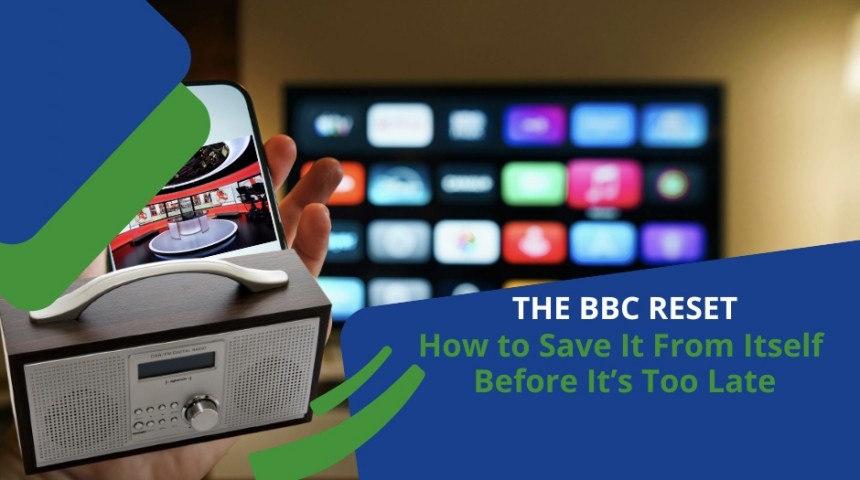
The BBC Reset: How to Save It From Itself Before It’s Too Late
My plan to brake the BBC free from the past and make it fit for the future.
The BBC is at a crossroads, and not for the first time—but this time the numbers are forcing the issue. A £500 million saving required over the next two years, combined with workforce cuts and the potential loss of entire channels announced today to staff, signals something deeper than routine restructuring at the BBC is needed to save the British Broadcasting Corporation from becoming a footnote in the history books.
This isn’t just about trimming budgets; it’s about whether the BBC continues as a modern public service or slowly declines under the weight of its own legacy systems.
Right now, the biggest problem isn’t the content. The BBC still produces world-class journalism, drama, and radio. The real issue is how that content is delivered. The organisation is still maintaining a sprawling, expensive infrastructure designed for a different era—multiple broadcast platforms, overlapping services, and linear channels that fewer people are actually watching or listening to in real time. Meanwhile, audiences have already moved on.
A realistic way forward starts with accepting that digital is no longer an add-on; it’s the core. Radio is the most obvious place to begin. The BBC operates across FM, DAB, MW, and online, which is expensive and increasingly unnecessary. Moving all additional and niche radio services onto BBC Sounds would immediately reduce complexity. Core stations can remain on FM for accessibility, but DAB and MW transmission should be phased out. That alone cuts a significant chunk of infrastructure cost while aligning with how people actually listen—on phones, smart speakers, and in connected cars.
Television needs the same kind of honesty. The idea that the BBC must maintain a wide range of linear channels no longer holds up. Keeping BBC One and BBC News as universal, free-to-air services preserves the public service backbone, but everything else can move to BBC iPlayer and Freely. That’s where audiences already expect to find content, and it eliminates duplication in scheduling, playout, and distribution.
Once content is primarily delivered digitally, funding can evolve in a way that doesn’t undermine the BBC’s core purpose. Live broadcasts and programmes within seven days of airing should remain free, maintaining universal access. Beyond that window, viewers could either subscribe or choose a free, advert-supported option. This creates a new revenue stream without putting up a hard paywall around essential content. It also allows the BBC to compete more realistically with global platforms like Netflix, which have reshaped audience expectations around convenience and depth of catalogue.
Distribution is another area where legacy thinking is costing money. Maintaining satellite services and a full suite of Freeview channels made sense when those were primary platforms, but now they are just one option among many. Scaling back to BBC One and BBC News on Freeview, and removing satellite distribution entirely, would simplify operations and push audiences gently toward IP-based delivery, where the long-term future clearly sits.
Radio, too, has untapped potential to generate income without losing its identity. Allowing limited advertising and sponsored content—done carefully and with strict safeguards—could bring in meaningful revenue. This wouldn’t mean turning BBC radio into commercial radio, but it would acknowledge that a small amount of commercial support could reduce pressure elsewhere in the system.
Another shift, more structural but potentially powerful, is opening parts of BBC radio to external operators. Instead of the BBC directly running every station, independent providers could bid to deliver services under contract, with clear requirements around format, quality, and editorial standards. The BBC brand and oversight remain, but delivery becomes more flexible and cost-efficient. It’s a model used in other sectors and could introduce competition and innovation without abandoning public service values.
Taken together, these changes don’t dismantle the BBC—they strip away the parts that no longer make sense and reinforce the parts that still matter. The savings come not from blunt cuts to content, but from reducing duplication, modernising delivery, and creating new income streams. Audiences would still get free access to essential services, but with a better, more intuitive digital experience. And crucially, the BBC would stop trying to be everywhere in every format, and instead focus on doing fewer things properly.
What’s being proposed here isn’t painless, and it would require political and institutional will that hasn’t always been present. But the alternative is already visible: gradual decline, shrinking budgets, and reactive cuts that chip away at quality year after year. A controlled transition, even a bold one, is far less risky than that.
The BBC has reinvented itself before. The difference now is that the direction of travel is obvious. The question is whether it chooses to move with it—or gets dragged along too late.
Implementation Plan
The shift doesn’t need to happen overnight, but it does need to be deliberate, staged, and disciplined. The key is sequencing—cutting costs early where possible, while building the digital infrastructure that replaces them.
Step 1: Immediate freeze and audit (0–3 months)
Halt any non-essential spending across distribution, commissioning, and infrastructure. At the same time, carry out a full audit of transmission costs across FM, DAB, MW, satellite, and Freeview. This establishes exactly where the biggest savings can be realised quickest, and avoids blind cuts to content.
Step 2: Announce the digital-first transition (within 3 months)
Publicly commit to a clear direction of travel: radio consolidation onto BBC Sounds and TV consolidation onto BBC iPlayer and Freely.
This is as much about audience behaviour as it is about cost—people need time to adapt, and certainty accelerates that shift.
Step 3: Begin radio restructuring (3–9 months)
Move all additional and niche radio stations to digital-only via BBC Sounds.
Start phased shutdown of MW services first, followed by DAB.
Maintain FM for core stations during the transition to protect accessibility.
Step 4: Reduce linear TV channels (6–12 months)
Gradually close or migrate non-core channels into iPlayer and Freely.
Retain only BBC One and BBC News as live broadcast anchors.
Reposition iPlayer as the primary destination for all other content.
Step 5: Cut satellite and streamline Freeview (6–18 months)
Exit satellite distribution contracts as they expire.
Scale Freeview presence down to BBC One and BBC News only.
Redirect savings into streaming infrastructure and content delivery.
Step 6: Launch hybrid funding model (within 12 months)
Introduce the 7-day free window across all content.
After that:
Offer subscription access
Or free viewing with adverts
Build this directly into iPlayer so the experience is seamless rather than fragmented.
Step 7: Introduce limited radio commercialisation (12–18 months)
Pilot carefully controlled advertising and sponsorship on selected radio services.
Set strict limits on ad load and protect news output from any commercial influence.
Scale gradually based on audience response and revenue performance.
Step 8: Open competitive bids for radio services (12–24 months)
Invite external providers to bid for operating selected local and national stations.
Contracts must lock in:
Editorial standards
Output format
Budget discipline
The BBC retains ownership and oversight, but reduces operational burden.
Step 9: Workforce transition and redeployment (ongoing)
Align staffing with the new structure:
Retrain where possible into digital roles
Reduce duplication in broadcast operations
Focus talent on content rather than distribution
This ensures cuts are strategic, not simply numerical.
Step 10: Reinforce the BBC’s core mission (ongoing)
Throughout the transition, protect what actually defines the BBC:
Trusted news
National events
Cultural programming
Universal access
Everything else should serve that purpose—not compete with it.
This approach spreads the change over roughly two years, matches the required savings timeline, and avoids the usual trap of cutting services before viable alternatives are in place.