
 #politics
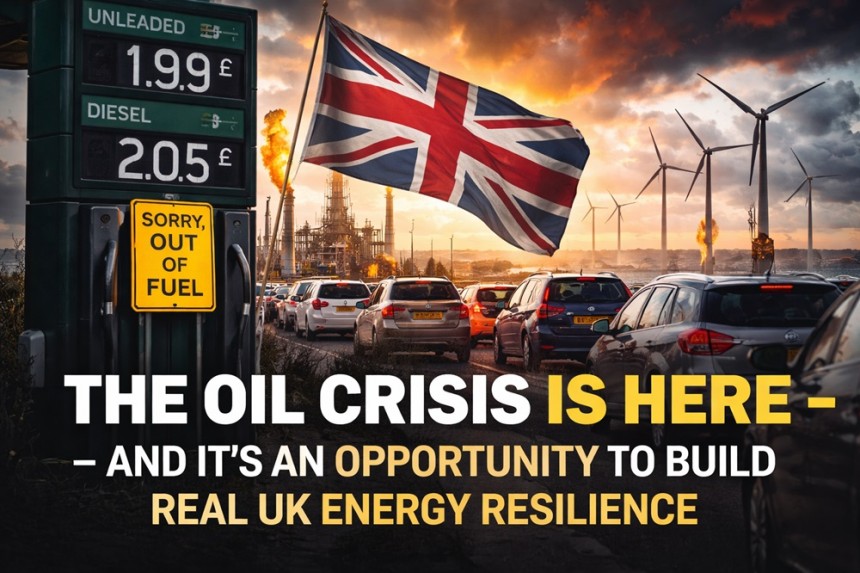
The Oil Crisis Is Here — And It’s an Opportunity to Build Real UK Energy Resilience
The oil crisis has begun. The UK faces prolonged high costs, structural weakness, and a real risk of recession — but also a rare opportunity to rebuild energy resilience for the future.
This isn’t a warning anymore. It’s not something on the horizon or a risk to prepare for. The oil crisis is already here, and it’s starting to work its way through the system.
Prices have surged on geopolitical tension, supply uncertainty, and market reaction — all the usual triggers. But what matters now isn’t just the spike itself. It’s what happens next, and how long the effects linger. Even when oil prices eventually begin to fall, that drop won’t be felt immediately. There’s always a delay between wholesale prices and what people actually pay at the pump. That means households and businesses will still be dealing with elevated costs well into late Q3, possibly beyond.
That’s where the real pressure builds. Energy costs don’t exist in isolation. They feed into everything — transport, food, manufacturing, logistics. As those costs rise, spending slows, businesses tighten, and growth stalls. That combination creates the kind of conditions that can push economies into recession, not gradually, but sharply. We’ve seen it before.
The UK, in particular, is exposed. Over decades, domestic production capacity has declined, storage has been reduced, and reliance on imports has increased. In stable times, that might seem efficient. In times like this, it leaves very little control over the situation. Short-term measures like cutting fuel duty may ease some pressure, but they don’t address the underlying issue — supply.
Even in a best-case scenario, where tensions ease quickly, there is no instant reset. Infrastructure takes time to repair, supply chains take time to rebalance, and production doesn’t just switch back on overnight. The effects of this kind of shock carry on long after the headlines move on.
But this is exactly why the current situation should be seen differently. Not just as a crisis to manage, but as a window to change direction.
The UK has an opportunity here to build something more resilient. One of the most practical paths forward is the development of domestic e-fuel production. Using renewable energy to produce synthetic fuels locally changes the fundamentals. It reduces dependence on volatile global markets, strengthens energy security, and does it in a way that works with the existing vehicle fleet and infrastructure.
This isn’t about replacing everything overnight. It’s about adding a layer of resilience that currently doesn’t exist.
The UK already has key advantages — strong renewable energy potential, particularly offshore wind, and the industrial capability to scale new technologies. With the right investment and coordination, e-fuels could become a serious part of the national energy mix, not just a niche solution.
What matters now is how this moment is used. If the response is purely reactive, focused only on short-term relief, then the same vulnerabilities will remain, and the same cycle will repeat. Another shock, another scramble.
But if this is treated as a turning point, there’s a chance to build something far more stable. A system that can absorb shocks instead of amplifying them. A system that gives the UK more control over its own energy future.
The oil crisis is already here. The question is whether it stays a crisis — or becomes the catalyst for something better.

The use of blockchain technology in promoting transparency and account...