
 #politics
An Inconsistent Tale of Two Gates and Planning Permissions
One rule for them and a one rule for everyone else.
In various locations across the country, gates serve as simple yet significant structures used to delineate boundaries and provide access through fences or walls. Although they may seem mundane, the installation of gates can often lead to complex and perplexing situations, as demonstrated by two recent cases that unfolded in the picturesque town of Penrith.
The Farmer's Predicament: A Clash of Livestock and Planning Protocols
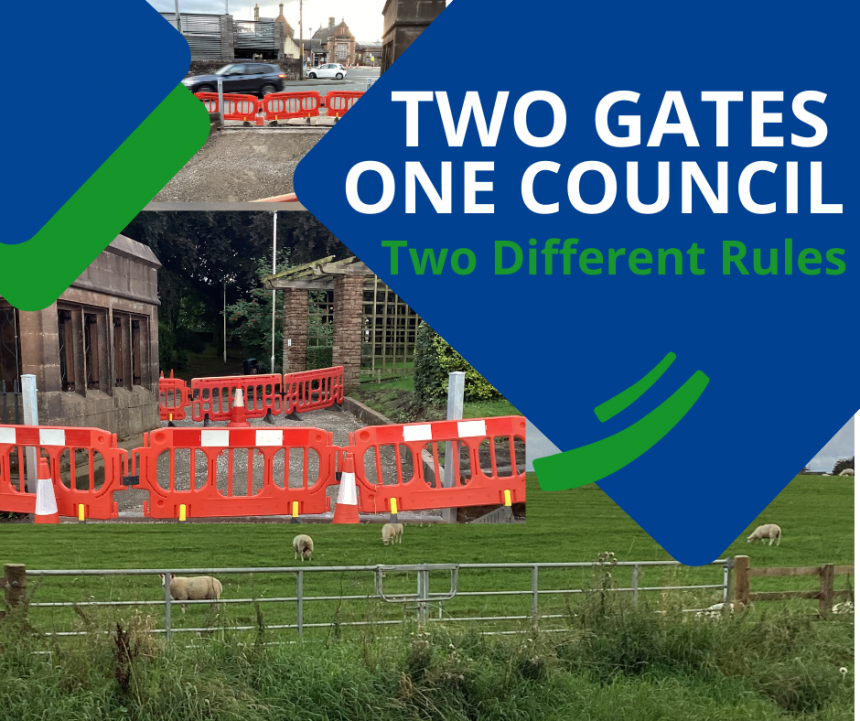
Nestled on the outskirts of Penrith, a diligent farmer took it upon himself to enhance the functionality of his fields and safety of moving livestock between fields, by adding a gate that would streamline the movement of his livestock and make it safer by reducing the time and distance livestock moved on the highway. What might have appeared to be an ordinary upgrade swiftly transformed into a labyrinthine administrative ordeal. In his pursuit of efficiency and reduced livestock travel time along a country road with a 40mph speed limit, the farmer erected a standard 5-bar metal gate connecting his fields either side of a road. The unforeseen twist: the local council insisted he obtain retrospective planning permission, that the council then refused citing vague concerns about safety and the handling of livestock on the road. A perplexing decision, considering the farmer could already utilize a pre-existing gated access to drive livestock along the road for his cattle transportation needs.
A Tale of Two Gates: Contradictions in the Planning Panorama
Contrasting starkly with the farmer's experience, another narrative unfurled within the heart of Penrith itself. In close proximity to an aged castle, a serene park housed a revered war memorial gateway commemorating the sacrifices of WWI. Somewhat recently, a portion of the sandstone wall and the accompanying metal railings adjacent to this revered memorial were dismantled to pave the way for a novel gated vehicle access point. Curiously, this construction venture was undertaken without the required planning permission. It's particularly noteworthy that the project necessitated listed building consent due to its adjacency to a Grade II listed structure. This perplexing dichotomy becomes even more confounding when one learns that the council, responsible for the park's development, voluntarily withdrew the submitted plans for this very endeavor. The council contended that the project was well within the bounds of permitted development guidelines.
Divergent Standards: Whose Rules Apply?
The stark incongruity between these two cases gives rise to a slew of pressing questions regarding the council's application of planning permissions. While the farmer's humble gate was subjected to rigorous regulations, the council's own project appeared to be exempt from the rules, despite being situated beside a protected listed structure. This glaring inconsistency underscores the urgency for a fair and impartial planning process that treats all constituents equitably.
Seeking Redress: A Call for Scrutiny
Frustrated by the council's unequal treatment, parties have taken a proactive stance to challenge these glaring disparities. A formal letter has been sent to the Secretary of State, delineating the myriad concerns pertaining to the local planning authority's conduct. The aspiration is for a comprehensive inquiry that culminates in accountability and rectification. In cases where a local planning authority is found wanting in fulfilling its obligations, the Secretary of State can opt to place it under special measures, a step that could potentially restore equity and adherence to regulations.
Shuttering the Gates on Inequity
The narratives surrounding these two gates amplify the significance of a consistent and unbiased planning protocol. Regardless of whether it pertains to farmers, councils, or revered listed structures, uniformity in rule application is imperative. As the events continue to transpire in Penrith, they serve as a salient reminder that even seemingly inconsequential facets of urban planning can unearth deeper-rooted issues and inequities in local government.